How to Get More Flexible: A No-Nonsense Guide for Beginners
Quick Summary: Flexibility is a skill, not a genetic trait. You don’t need hours a day-just 10–15 minutes of consistent stretching combined with mobility work will get you real results without the pain.
Think you’re just “born stiff” and that’s that? Think again. The truth is, flexibility isn’t a magical trait reserved for yogis and gymnasts-it’s a skill. And like any skill, you can build it with consistency, the right moves, and a little patience.
1. What Does It Mean to Be Flexible?
At its core, flexibility is simply how well your joints and muscles can move through a full range of motion.
Everyone’s starting line looks different. Your genetics, daily habits, past injuries, and strength-training history all play a role. But your current state isn’t permanent. With regular attention, your body adapts, opening up space you didn’t know you had.
2. The Golden Rules of Flexibility Training
Forget hunting for one magic stretch-it doesn’t exist. Real improvement comes from a smart, balanced approach:
Warm up first: Never dive deep into stretching with cold muscles.
Keep it balanced: Target major areas (hamstrings, hips, quads, calves, glutes, shoulders, chest, back) rather than just one tight spot.
Move with control: Use smooth, controlled motions instead of forcing a position.
Prioritize consistency: A short daily routine beats a grueling weekly marathon every time.
Allow recovery: Give your body time to rest and adapt.
3. Top 5 Beginner-Friendly Stretches
Start with basic movements where you are in total control:
1. Standing Hamstring Stretch: Stand tall, hinge gently from your hips, and fold forward. No bouncing-just a nice, easy pull down the backs of your legs.
2. Standing Quad Stretch: Hold a wall for balance, bend one knee, and bring your heel toward your glutes while keeping your knees close together.
3. Low Lunge: Step one foot forward, drop your back knee to the floor, and shift your hips forward slightly to open up tight hip flexors.
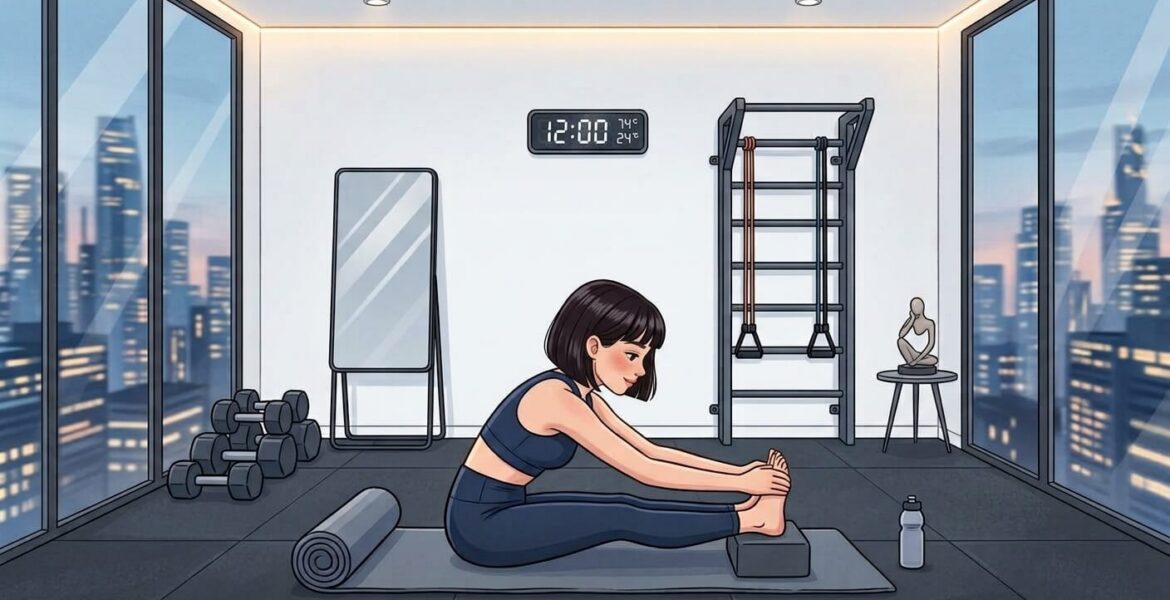
4. Seated Forward Fold: Sit with your legs straight out, and reach forward from your hips. Forget touching your toes-go only as far as feels comfortable.
5. Figure-Four Stretch: Lie on your back or sit down, cross one ankle over the opposite thigh, and draw your legs slightly toward you for a gentle glute release.
4. Stretching vs. Mobility: Why You Need Both
Static stretching builds passive length, but mobility builds active control. Think hip circles, controlled leg swings, and thoracic rotations. Combining both ensures you aren’t just flexible, but strong and stable within that new range of motion.
Before a workout: Use dynamic movements and mobility work to wake up your joints.
After a workout (or on a rest day): Focus on slower static stretches and longer holds.
5. Your 15-Minute Home Routine
You don’t need a fancy studio; a corner of your living room floor is plenty.
Warm-up (3 mins): Light marching in place, arm circles, easy leg swings.
Mobility (4 mins): Hip circles, gentle lunges, upper body rotations.
Stretching (8 mins): Hamstring, hip flexor, quad, figure-four, and calf stretches. Move slowly and breathe normally.
6. Common Traps to Avoid
Forcing the stretch: Pain is a red flag, not a badge of honor. Ease up.
Skipping the warm-up: Trying to stretch cold muscles makes progress much harder.
Inconsistency: Random monthly blowouts won’t build lasting habits.
Comparing yourself to others: Your body and anatomy are unique. Focus on your own journey.
Becoming flexible isn’t an overnight fix; it’s a sustainable practice. Start small, mix in some mobility, stay consistent, and let your body adapt at its own pace.